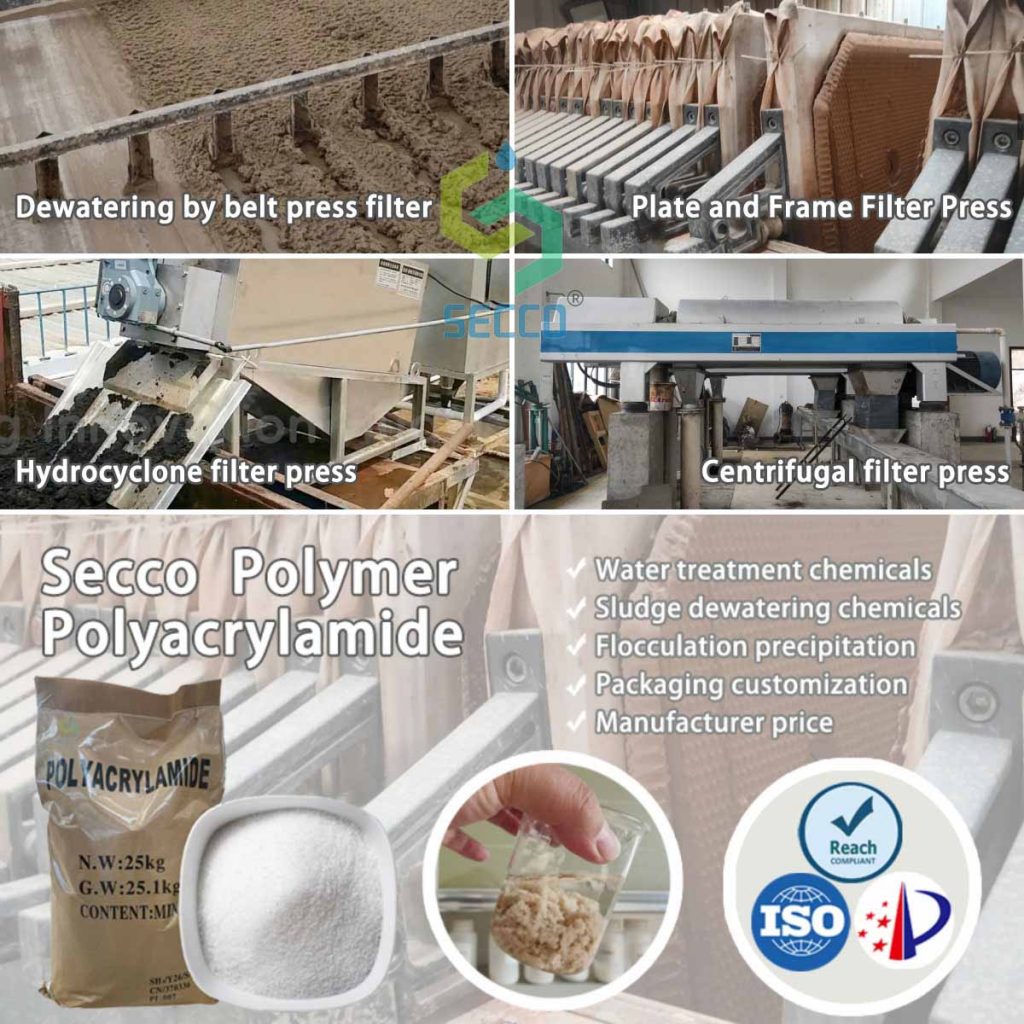
I. Core Functions of Polyacrylamide in Sludge Dewatering
Polyacrylamide (PAM) serves as a flocculant (conditioner) in sludge dewatering, significantly improving dewatering efficiency. Its mechanisms of action include two primary aspects:
Charge Neutralization — The charged groups on PAM molecular chains neutralize the negative charges on sludge particle surfaces, reducing electrostatic repulsion and promoting the aggregation of fine particles.
Adsorption Bridging — The long molecular chains of PAM form “bridges” between multiple sludge particles, connecting dispersed fine particles into larger, denser flocs. This process effectively releases the water trapped between sludge particles, making subsequent mechanical dewatering more efficient and significantly reducing the moisture content and volume of the sludge cake.
In practice, Cationic Polyacrylamide (CPAM) is the most commonly used type for sludge dewatering, particularly suitable for organic-rich municipal sludge. However, the specific selection depends on sludge characteristics (such as charge properties, organic matter content, and solids content) as well as the type of dewatering equipment.
II. PAM Selection Guide for Four Types of Sludge Dewatering Equipment
Belt Filter Press
Belt filter presses achieve solid-liquid separation through gravity drainage and mechanical squeezing, and have relatively high requirements for PAM, needing to form large and compact flocs.
Selection Recommendations: Typically use Cationic Polyacrylamide (CPAM) with an ionicity of 30%–50% and a molecular weight of 8–15 million. When flocculation effects are similar, products with lower molecular weight and higher ionicity are preferred — high molecular weight produces overly large flocs with higher moisture content, which hinders subsequent squeezing and may cause “sludge run-off”.
Function: Enhances sludge settling in the gravity drainage zone and improves cake formation under pressure.
Common Issues: If dewatering results are unsatisfactory, besides checking the chemical type, preparation concentration, and dosage, also check whether the belt speed is too fast (resulting in insufficient dewatering time) or whether the filter cloth tension is appropriate.
Typical Cake Moisture Content: 75%–85%.
Plate & Frame Filter Press
Plate and frame filter presses rely on high-pressure pumps to feed sludge into sealed chambers, where filtration through filter cloths achieves dewatering. This equipment has the lowest requirements for PAM.
Selection Recommendations: As long as flocculation can be achieved, sludge cake can generally be produced. Recommended products include low-ionicity cationic PAM (10%–30%) or non-ionic PAM (for acidic sludge), with a molecular weight of 5–10 million. Plate and frame presses should use PAM with moderate viscosity — excessive viscosity can cause filter cloth adhesion, affecting dewatering performance and making cloth cleaning quite troublesome. In some cases, inorganic flocculants such as polyaluminum chloride (PAC) may also be used in combination with PAM.
Function: Reduces filtrate turbidity and increases solids content in the cake.
Precautions: Overdosing PAM can cause filter cloth adhesion, affecting dewatering effectiveness. Dewatering efficiency is also closely related to feed time, holding pressure, and other operational parameters.
Typical Cake Moisture Content: 60%–70% — the best dewatering performance among the four equipment types.
Screw Press
Screw presses achieve dewatering through the squeezing action between the screw shaft and static/dynamic rings, requiring PAM to form densely compacted flocs.
Selection Recommendations: Must use medium-ionicity cationic PAM (20%–40%) with a molecular weight of 6–12 million. Typical recommended parameters are molecular weight above 10 million and ionicity above 40%. Higher ionicity provides better permeability and superior dewatering results.
Function: Prevents leakage of fine particles and reduces equipment energy consumption.
Precautions: Before using a screw press, PAM must be dosed to achieve sludge-water separation before feeding into the machine for pressing.
Typical Cake Moisture Content: 85%–95%.
Centrifuge (Decanter Centrifuge)
Centrifuges utilize high-speed rotation to generate centrifugal force for solid-liquid separation, and have the highest requirements for PAM.
Selection Recommendations: Must use high-ionicity cationic PAM (40%–60%) with a molecular weight of 10–15 million. Ionicity should be above 50%. The chemical must enable sludge to rapidly form large and compact flocs capable of withstanding the intense shear forces inside the centrifuge.
Function: Accelerates solid-liquid separation speed and reduces centrate turbidity.
Key Points: The chemical dosage must be precisely matched to the feed sludge volume to ensure optimal treatment results and prevent equipment malfunctions.
Typical Cake Moisture Content: 80%–85%.
III. Summary of Selection Considerations
To select the appropriate PAM for your sludge dewatering equipment, we recommend following this approach:
Identify Sludge Characteristics: Understand the sludge source (municipal/industrial), charge properties, organic matter content, and solids content — this is the foundation for selection.
Match Equipment Requirements: Different equipment has different requirements for floc size, compactness, and formation speed — belt filter presses and centrifuges require high molecular weight, shear-resistant PAM; plate and frame presses are suitable for low-ionicity products.
Conduct Jar Tests: After theoretical selection, be sure to verify and determine the optimal PAM type and dosage through jar tests. Typical dosage is 0.2–0.6 kg per ton of dry solids.
Proper Preparation and Dosing: PAM solution concentration is typically controlled at 0.1%–0.3%, avoiding excessive stirring that can cause polymer degradation.
Henan SECCO Environmental Protection Technology Co., Ltd. is dedicated to the R&D, production, and sales of polyacrylamide and other water treatment chemicals. The company’s main products include cationic, anionic, and non-ionic polyacrylamide and other polymer flocculants. We provide complete sewage flocculation treatment solutions tailored to different application scenarios. If you have specific sludge types or on-site conditions requiring consultation, please feel free to contact us for more targeted selection recommendations.