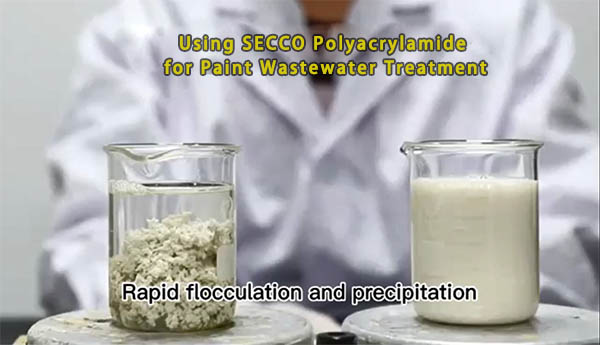
Treating paint wastewater with polyacrylamide (PAM) is a classic and highly effective application. Below is a detailed breakdown of the principles, polymer selection, operational procedures, and key considerations.
Understanding the complexity of this wastewater is crucial:
Complex Composition: Contains resins (acrylic, epoxy, alkyd, etc.), organic solvents (aromatics, esters, ketones), pigments (potentially with heavy metals like lead, chromium), additives, and emulsifiers.
High COD & Color: Extremely high concentration of organic pollutants and intense color.
High Stability: Especially for water-based paint wastewater, the colloidal particles carry a negative charge. Electrostatic repulsion (double layer) keeps them stably suspended, preventing natural settling.
High Toxicity: Some solvents and heavy metals are biologically toxic.
PAM primarily functions as a flocculant or coagulant aid. Its core mechanisms are bridging and sweep flocculation.
Charge Neutralization: Cationic PAM carries positive charges that neutralize the negative surface charges of paint colloids. This destabilizes the particles (compresses the double layer), causing them to aggregate.
Adsorption & Bridging: The long polymer chains of PAM adsorb onto multiple destabilized particles or micro-flocs, acting as “bridges” to connect them into larger, denser agglomerates (flocs).
Sweep Flocculation: As the large flocs settle, they enmesh and “sweep” fine suspended solids out of the water, significantly improving clarity.
Choosing the wrong PAM type will lead to poor results. Jar testing is essential to determine the optimal product based on wastewater characteristics and pretreatment.
| Type | Ionic Charge | Ideal Application | Role in Paint Wastewater Treatment |
|---|---|---|---|
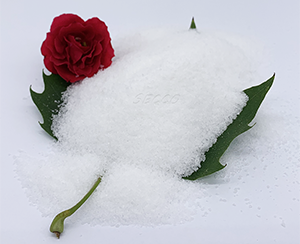
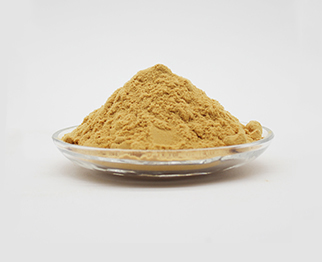
| Cationic PAM | Positive | Most common choice. Effective for negatively charged organic colloids/solids. Particularly suitable for water-based paint wastewater. | Primary Flocculant. Directly neutralizes paint particle charges and bridges them into flocs. Commonly used in the sludge dewatering stage. |
| Anionic PAM | Negative | Effective for positively charged inorganic suspensions (e.g., metal hydroxides). Typically used in combination with inorganic coagulants (e.g., PAC). | Coagulant Aid. After PAC coagulates colloids into micro-flocs, its long chains provide bridging to form larger, denser flocs. |
| Non-ionic PAM | Neutral | Suitable for weakly acidic, high-salinity, or mixed inorganic/organic systems. Less sensitive to pH changes. | When charge interaction is weak, it relies on its strong adsorption and bridging capabilities. |
General Guidance:
For wastewater after pretreatment (e.g., with PAC coagulation): Anionic PAM is often used as a coagulant aid.
For direct treatment or sludge dewatering: Cationic PAM with medium to high charge density is typically used.
Jar testing is mandatory to identify the best type and dosage.
Using PAM alone is insufficient; a combined process is standard. A typical flow is as follows:
Collection & Pretreatment:
Segregate different paint waste streams (e.g., spray booth water, gun wash water).
Remove large debris via a screen or grate.
Demulsification / Coagulation (Core Pretreatment):
Adjust pH to the optimal range (often 7-9, requires testing).
Add an inorganic coagulant like Polyaluminum Chloride (PAC) or Polyferric Sulfate (PFS). These efficiently neutralize charges and form initial micro-flocs (pinpoint floc).
This step is key to breaking the stability of the paint wastewater.
Flocculation Reaction:
Slowly add the prepared PAM solution (typically 0.1% concentration) to the coagulated water.
Under gentle agitation (to avoid shearing flocs), the long PAM chains bridge the micro-flocs into visible, large, and dense flocs.
Solid-Liquid Separation:
Sedimentation: Stop agitation and allow flocs to settle in a clarifier (e.g., inclined plate settler).
Dissolved Air Flotation (DAF): For lighter flocs (e.g., containing oily components), DAF is more effective. Microbubbles attach to flocs and float them to the surface for skimming.
The separated supernatant is clarified and proceeds to secondary treatment (e.g., biological) or discharge.
Sludge Dewatering:
The paint sludge from sedimentation/DAF has high moisture content and requires dewatering.
Cationic PAM is typically used as a sludge conditioner/dewatering agent. It is mixed with the sludge to form strong flocs suitable for dewatering via a filter press or centrifuge, producing a semi-solid “cake” for disposal.
Solution Preparation: Use clean water (tap water). Sprinkle PAM granules slowly into the stirred water to avoid clumping. Typical concentration is 0.1%-0.3%. Prepare fresh and use within 24 hours.
Dosing Sequence: Always add inorganic coagulant (PAC) first, then PAM. Reversing the order drastically reduces efficiency.
Mixing Intensity: Rapid mixing is needed for coagulant dispersion; slow mixing (gentle agitation) is required during PAM addition for floc growth.
Dosage: Determine the optimal dose via jar testing. Under-dosing is ineffective; over-dosing can cause re-stabilization or saturation, reducing performance and increasing cost.
Safety & Environment: PAM itself is non-toxic, but its monomer (acrylamide) is toxic. Use high-quality products with low residual monomer. Wear appropriate PPE during handling. The treated sludge cake is often classified as hazardous waste and must be handled by licensed disposers.
Using Polyacrylamide to treat paint wastewater is fundamentally a physico-chemical process of “demulsification/coagulation followed by flocculation and separation.” PAM (especially anionic and cationic types) plays the critical role of “bridge builder” and “sweeper.” Success hinges on:
Accurate polymer selection (via jar testing).
A rational process flow (Coagulation + Flocculation + Separation).
Precise dosing control and attention to operational details.
For large-scale or complex paint wastewater streams, consulting with specialized environmental engineering firms for systematic process design and commissioning is recommended.