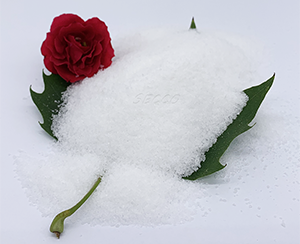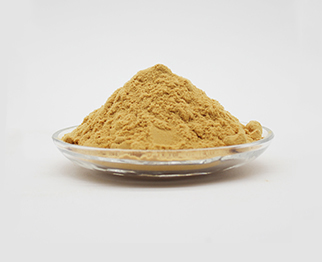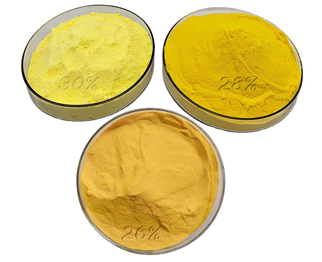
Against the background of tightening global environmental policies and the paper industry’s transformation towards a green, low‑carbon future, how to efficiently utilise resources, reduce production costs and ensure compliant wastewater discharge has become a core challenge for many paper enterprises. Among various solutions, polyacrylamide (PAM) – with its excellent flocculation, sedimentation, thickening and strengthening properties – has evolved from a simple “auxiliary additive” into an indispensable processing aid and a key element for process control in modern papermaking.
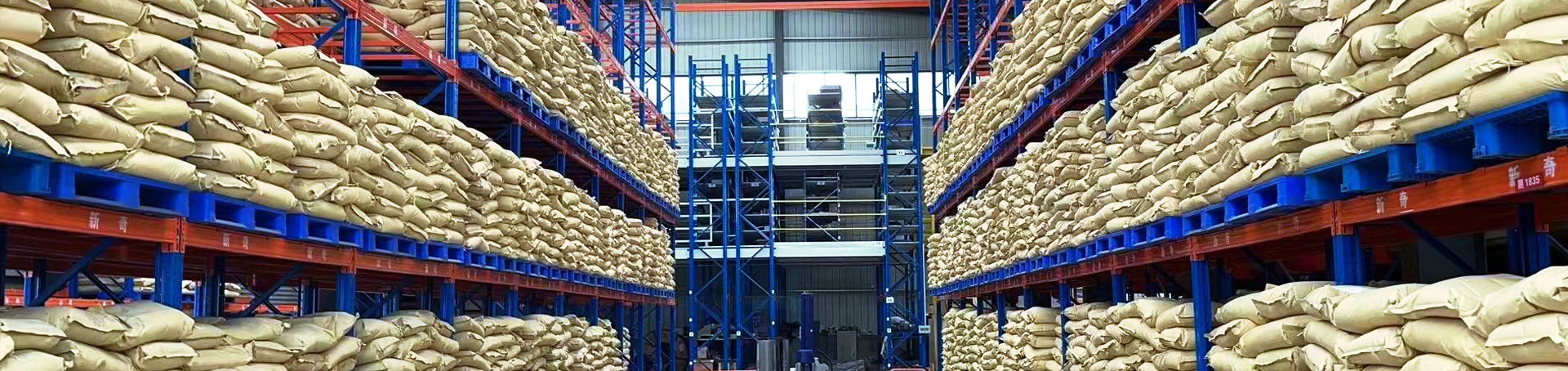
As a high‑tech enterprise based in Gongyi City (a renowned national industrial cluster for water treatment chemicals), Henan Secco Environmental Protection Technology Co., Ltd. specialises in the R&D, production and sale of water treatment chemicals. We operate a modern production line with an annual capacity of 50,000 tonnes of polyacrylamide, offering cationic, anionic and non‑ionic polymer flocculants. For the paper industry, our products can be customised according to different pulp characteristics, machine speeds and environmental requirements, providing paper mills with precise, high‑efficiency papermaking aid solutions.
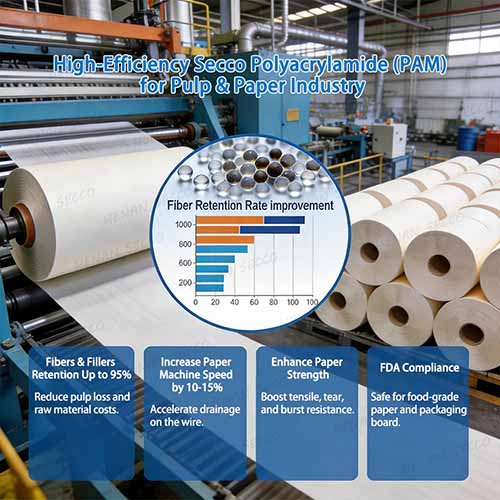
During the wet‑end of papermaking, fine fibres and expensive fillers (e.g. calcium carbonate, titanium dioxide) are easily lost with the white water. As a highly efficient retention and drainage aid, PAM works through “charge neutralisation” and “bridging” – effectively aggregating negatively charged fibres and filler particles into larger flocs, thereby increasing single‑pass retention. This not only saves fibre raw materials, reduces white water solids and lowers wastewater treatment loads, but also improves dewatering of the stock, accelerates water removal on the machine, reduces energy consumption in the forming and drying sections, and enhances paper smoothness and opacity.
Effectiveness of different PAM types in retention & drainage:
Cationic polyacrylamide (CPAM): Positively charged chains strongly attract negatively charged fibres and fillers through electrostatic interaction, forming large flocs by bridging. It can increase filler retention by 10–30% and improve dewatering efficiency by 10–20%. Particularly suitable for coated paper, printing paper and other grades with high filler retention requirements.
Anionic polyacrylamide (APAM): Negatively charged; must be used together with a cationic retention aid such as aluminium salts or polyaluminium chloride. The cationic aid first neutralises the negative charges, then APAM bridges to form flocs. Filler retention improvement is typically 5–15% – often used for cost‑sensitive grades like tissue paper.
Non‑ionic polyacrylamide (NPAM): Mainly relies on physical forces (hydrogen bonding, van der Waals) for adsorption, unaffected by stock pH. Filler retention increase is about 5–10%. Suitable for speciality paper systems where charge interactions must be avoided.
Papermaking wastewater is complex, with high COD and high suspended solids. PAM is highly effective at capturing fine suspended particles. When used together with inorganic coagulants such as polyaluminium chloride, it efficiently removes organic matter and suspended solids. For the problematic biological sludge from paper mills, using a PAM with the appropriate ionic charge can reduce sludge moisture content from over 99% down to 70–80%, drastically reducing sludge volume and cutting solid waste disposal costs.
Besides wet‑end applications, PAM can also be used as a dry‑strength or wet‑strength agent. The long polymer chains of PAM contain large numbers of amide, carboxyl and other active groups, which form strong hydrogen bonds with cellulose fibre surfaces, significantly increasing fibre‑to‑fibre bonding strength. Adding an appropriate amount of PAM can markedly improve burst strength, tensile strength and interlayer bond strength – especially important for linerboard, corrugated medium and other packaging paper grades. At low addition levels, anionic PAM also promotes good fibre dispersion, improving sheet formation and paper softness, while increasing machine speed and reducing energy consumption.
In practice, different ionic types of PAM play very different roles in papermaking. Anionic and non‑ionic grades are usually added to the pulp to improve dispersion and strength, while cationic grades show irreplaceable strong flocculation performance in white water recovery and sludge dewatering. Precise selection directly determines both effectiveness and total cost.
The R&D and technical service team at Henan Secco Environmental Protection Technology Co., Ltd. understands that close integration of chemical aids with papermaking processes is critical for reducing costs and improving efficiency. Based on each mill’s furnish composition, white water closure level and machine operating characteristics, we provide full‑process “turnkey” services – from precise product selection to on‑site trial optimisation. This helps our customers achieve the best balance between chemical usage and economic benefit. Our PAM series products have been widely adopted by major paper enterprises in more than 20 provinces and municipalities across China, significantly improving flocculation, sedimentation and dewatering efficiency, and earning high praise from our clients.
From a market perspective, the application of PAM in the paper industry has a bright future. According to statistics and forecasts by market research firm QYResearch, global sales of paper‑industry PAM reached US$685 million in 2025 and are expected to grow to US$922 million by 2032, representing a compound annual growth rate (CAGR) of about 4.4%. Another research source projects a CAGR of approximately 5.6%, with the market reaching US$3.78 billion by 2032. This steady growth reflects the strong and increasingly rigid demand for PAM‑based aids from the global paper industry.
On the path towards high quality, high efficiency and low emissions in the paper industry, Henan Secco Environmental Protection Technology Co., Ltd. – drawing on the deep industrial foundation of Gongyi City as a national cluster for water treatment chemicals, and leveraging its strong R&D and manufacturing capabilities – is committed to becoming a trusted partner for paper enterprises in China and around the world, providing high‑quality polyacrylamide products and contributing to a cleaner environment.