Piling construction, such as bored pile driving, generates large volumes of muddy wastewater composed of water, clay, bentonite, and fine rock cuttings. This wastewater forms a stable colloidal system that does not settle naturally under quiescent conditions. The suspended solids concentration is extremely high, typically exceeding 10,000 mg/L, and can pollute the surrounding environment if discharged untreated, while off‑site disposal of the slurry is costly. Achieving rapid mud‑water separation has therefore become a critical challenge in piling engineering.
1. Mechanism of Action: Breaking the Colloidal Stability
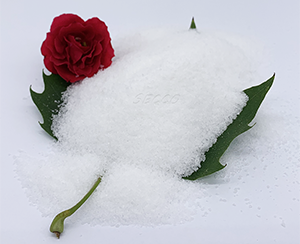
The effectiveness of polyacrylamide (PAM) in treating piling wastewater lies in its multiple mechanisms. The primary mechanism is adsorption bridging: the long molecular chains of PAM adsorb multiple suspended particles simultaneously, binding them into large flocs. This is particularly effective for fine clay‑mineral particles. Studies have shown that after adding anionic PAM (APAM), the particle size distribution characteristic value D₉₀ increases from 15.10 μm to 25.50 μm. Charge neutralisation also plays a role: cationic PAM can neutralise the negative charges on particles. However, for piling slurries dominated by inorganic minerals, APAM often performs better due to its superior bridging capability. In addition, APAM produces dense floc structures that facilitate subsequent dewatering. Experimental data indicate that at a concentration of 0.2%, an APAM dosage of just 3% by volume enables rapid flocculation within 10 seconds, reducing the moisture content by 29.5% and lowering the supernatant turbidity to 20 NTU after 2 hours.
2. Precise Selection and Combined Dosing
For piling wastewater, anionic PAM (APAM) is the first choice, with a recommended molecular weight of 14–16 million and a solution concentration of 0.25%–0.27% for optimal performance. Cationic PAM may be selected when the wastewater contains significant organic matter.
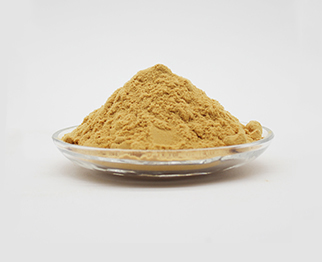
The combination of polyaluminium chloride (PAC) and PAM is a classic and highly efficient approach. PAC is added first to neutralise charges and destabilise colloids, followed by PAM to bridge the destabilised particles into large, dense flocs. Engineering data show that in coastal area pile‑foundation slurry treatment, combining 0.1 g/L APAM with 1.0 g/L PAC, together with a decanter centrifuge, can reduce slurry volume by over 70% and lower the moisture content of the solidified soil to 35%. In bored pile slurry, the optimal dosages are 0.3 g/L HPAM and 0.4 g/L PAC for the best dewatering performance.
3. Typical Application Cases
Shenzhen Qianhai Kerry Project adopted an integrated treatment unit using PAM and PAC for coagulation and flocculation of piling muddy wastewater, achieving solid‑liquid separation. The clarified water was recycled for construction, vehicle washing, and dust suppression, enabling green construction. Nanjing construction waste slurry treatment demonstrated that using cationic PAM (CPAM) achieved over 80% volume reduction after 20 minutes of settling, cutting off‑site disposal costs by 83%. A bridge piling project in Jiangxi further confirmed that APAM exhibits the best flocculation and dewatering performance among the three PAM types.
4. Henan Secco: Your Professional Partner for Piling Wastewater Treatment
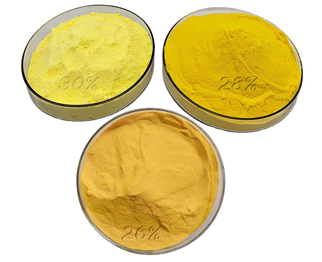
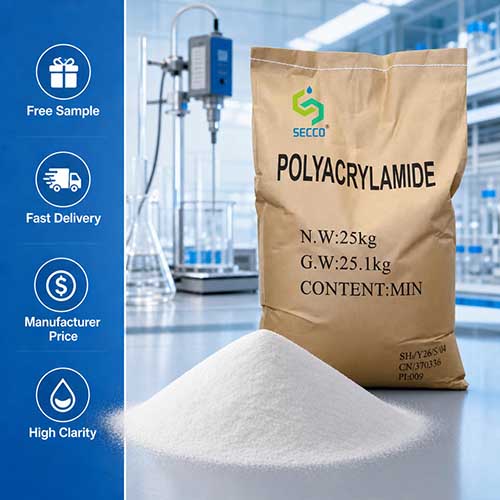
Henan Secco Environmental Technology Co., Ltd., located in the National Water Treatment Agent Industrial Cluster Zone of Gongyi City, specialises in manufacturing a full range of polyacrylamide (cationic, anionic, non‑ionic) as well as polyaluminium chloride and other water treatment chemicals. For piling wastewater, the company provides precise product selection, optimised combined dosing schemes (PAC + PAM), and full technical support, helping construction companies achieve efficient mud‑water separation and green operations.