The Key Role of Synergistic Use of Polyaluminum Chloride (PAC) and Polyacrylamide (PAM)
— An intuitive comparative experiment shows why “working together” beats “working alone”
In wastewater treatment, flocculation and sedimentation are among the most common and critical steps. However, many users initially tend to use only one type of flocculant — most often polyacrylamide (PAM). But does using PAM alone truly achieve ideal purification results?
To answer this question, Henan Secco Environmental Technology Co., Ltd. designed a simple and intuitive comparative experiment. The results clearly demonstrate that the synergistic use of polyaluminum chloride (PAC) and polyacrylamide (PAM) is the key to efficient wastewater treatment.
I. Experimental Process: Two approaches, dramatically different results
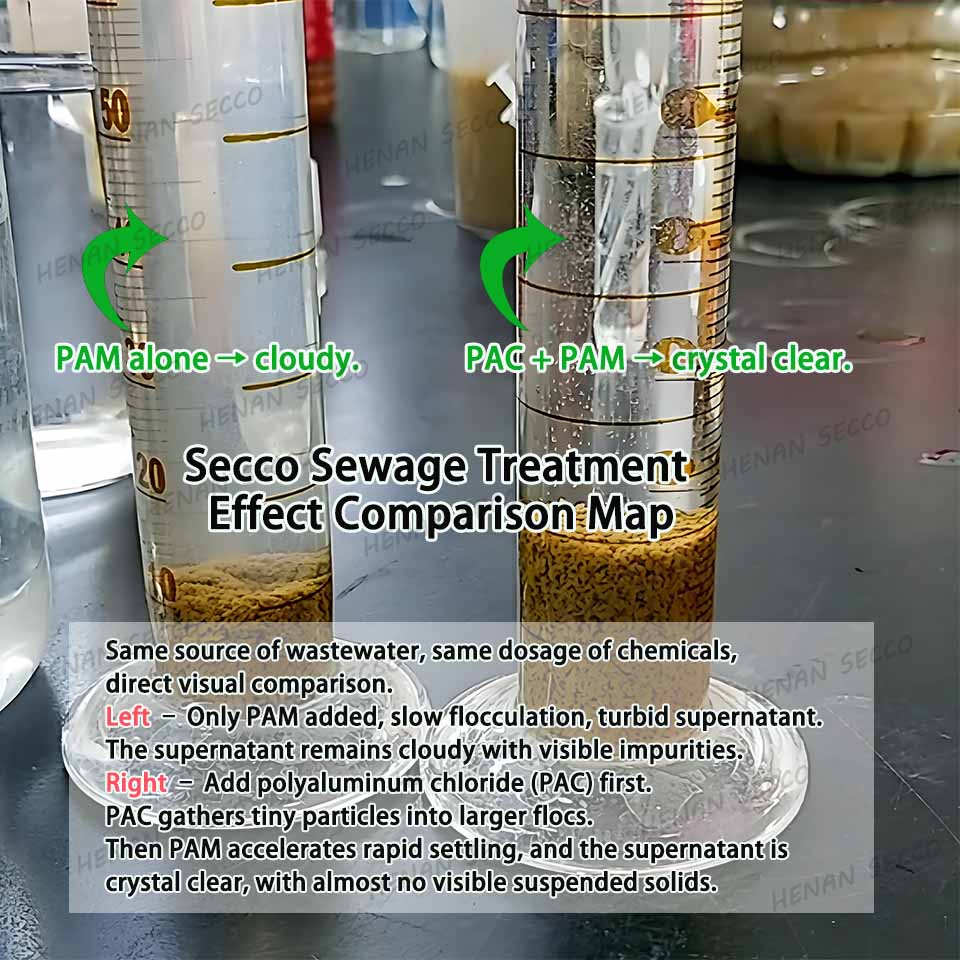
Approach 1: Using only PAM
Take a wastewater sample and add only PAM solution. Mix, flocculate, and allow to settle following standard procedures.
Observed phenomena:
Flocs form slowly, and are small and loose.
Settling speed is slow, with many fine particles still suspended in the supernatant.
The final supernatant is visibly turbid, with low transparency and significant residual impurities.
Approach 2: Adding PAC first, then PAM
Take an equal amount of the same wastewater sample. Step 1 – add PAC and mix rapidly for coagulation. Step 2 – add PAM, mix slowly, then allow to settle.
Observed phenomena:
After PAC addition, fine particles rapidly destabilize and aggregate into larger “flocs”.
PAM further bridges these flocs into even larger, denser aggregates.
Settling is extremely fast, and the supernatant is crystal clear, with almost no visible suspended solids.
| Treatment Method | Flocculation Performance | Settling Speed | Supernatant Quality |
|---|---|---|---|
| PAM alone | Small, loose flocs | Slow | Turbid, low transparency |
| PAC + PAM combined | Large, dense flocs | Fast | Crystal clear |
The visual contrast is striking: the water in the left cylinder remains yellowish and turbid, while the water on the right is as clear as crystal. This is the real difference brought by synergy .
III. Why is the combined use more effective than either alone?
To understand this, we need to look at the distinct roles of these two products in wastewater treatment:
Polyaluminum chloride (PAC) is an inorganic coagulant. Its main function is to neutralize the negative charges on the surface of colloidal particles and compress the double layer, thereby destabilizing the finely suspended particles and causing them to aggregate into smaller flocs (coagulation stage). PAC effectively removes turbidity, color, and heavy metal ions.
Polyacrylamide (PAM) is an organic polymer flocculant. Its main function is to use adsorption and bridging via its long molecular chains to further link the small flocs into large, dense aggregates, greatly accelerating settling and reducing suspended solids in the supernatant (flocculation stage).
The essence of synergy is: PAC destabilizes and initiates aggregation; PAM promotes growth and rapid settling.
If only PAM is used, the numerous negatively charged fine particles are not effectively neutralized, so PAM cannot perform its bridging role efficiently. The flocs remain small, settling is incomplete, and the supernatant remains turbid.
If only PAC is used, although small flocs may form, they are loose and settle slowly, and flocs may escape, preventing a truly clear supernatant.
Only PAC followed by PAM achieves a “1+1 > 2” treatment effect.
IV. Conclusion: Scientific combination leads to efficient purification
The experiment leads to a clear conclusion:
In wastewater treatment, PAC and PAM are not an “either/or” choice — they are a synergistic combination where both are essential.
Using either one alone cannot achieve optimal flocculation and sedimentation.
Only by following the “coagulation first, flocculation second” process and scientifically combining PAC and PAM can you achieve the comprehensive goals of clear effluent, rapid settling, chemical savings, and cost control.
V. Henan Secco Environmental Technology Co., Ltd. – Your Trusted Flocculant Partner
Henan Secco Environmental Technology Co., Ltd. is a high-tech enterprise specializing in the R&D, production, and sales of water treatment chemicals. Our main products include:
Polyacrylamide (PAM): anionic, cationic, and nonionic series for various water types.
Polyaluminum chloride (PAC): drinking water grade, industrial grade, high-purity white grade, and other specifications.
And other water purification materials.
We not only supply high-quality products, but also provide tailored selection advice and flocculation testing support to help every wastewater treatment facility find the most suitable synergistic solution.
If you are also experiencing issues such as “poor results from single-chemical use” or “turbid supernatant”, please contact us. Henan Secco will provide full-process technical support — from laboratory jar tests to field applications — so that every drop of water is thoroughly purified.